
From Joint Action to Mathematical Concepts: The Case of OЯTHO, a Digital–Tabletop Dyadic Game
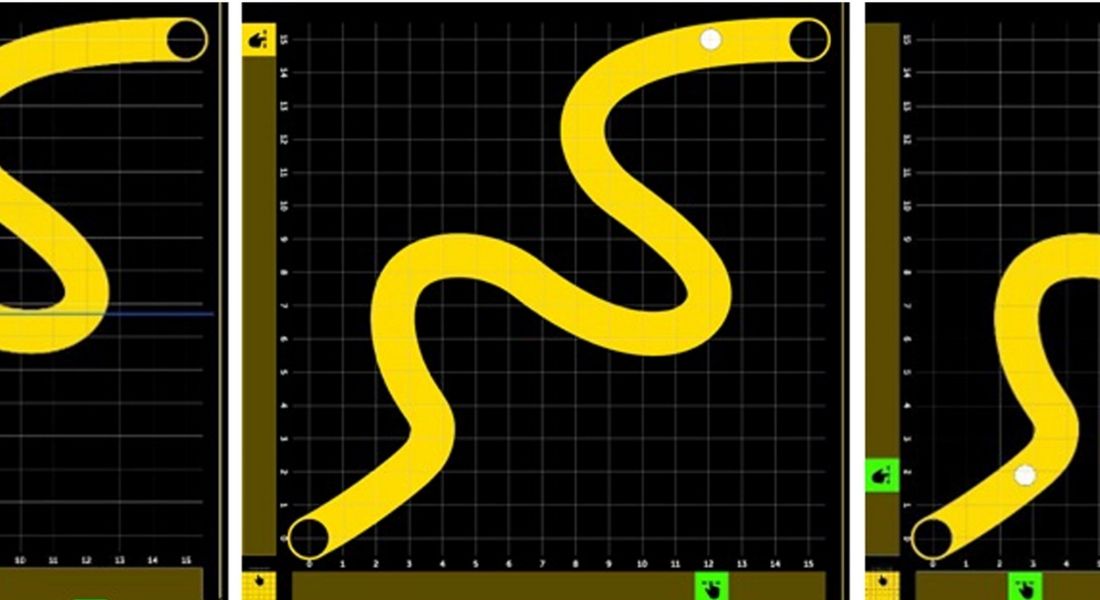
OЯTHO is a dyadic digital-tabletop game — a cross between Etch-a-Sketch and mini-golf — in which a “ball” needs to get from the Start of a maze to its End, yet while one player (the x-axis person) can only move the ball horizontally, the other player (the y-axis person) can only move it vertically. So the two players have to figure out how to move the ball together along diagonal legs of the maze, or else it’s “Game over!”

OЯTHO was designed to create opportunities for young players to first encounter the Cartesian system. By figuring out how to move together, children are to cultivate what we call “coordinate perception” — a techno-scientific two-dimensional attention to space whereby an object’s planar location is constituted as a cross-product of its respective x- and y-axis indexical projections, and its anticipated linear trajectory to the next target is likewise socially distributed as orthogonally apportioned axial thrusts.
OЯTHO advances through three game-mechanics levels that gradually shift hands-on action to symbolically mediated control, as our designed means of introducing disciplinary re-description of physical enactment in normative semiotic register, namely ordered pairs (e.g., [4, 7]). The game has been on exhibit in the LivingLab wing of the Copernicus Hall of Science in Warsaw, Poland, since the spring of 2023. Ever since, we have collected action logs, so we are now at about .5 million plays. For some of the pairs we also collect audio-video and eye-tracking data. This empirical corpus serves as a large-N research context to evaluate the design conjecture that mathematical concepts can emerge from the discourse that players develop spontaneously as their means of coordinating the enactment of simultaneous joint action.
From the perspective of complex dynamic systems, we will consider how the mazes’ structural constraints, such as navigating a narrow branch of the track, give rise to more efficient coordinated action tactics that endure after the constraints have been removed (hysteresis).
I will explain the game as exemplifying the action-based genre of the embodied-design framework, share results from our mixed-methods data analyses, raise pedagogical dilemmas around scaffolding curricular objectives in informal contexts, and sketch an underway project using machine-learning to extract optimal teaching practices and implement them in the form of an AI-driven virtual-reality OЯTHO companion for remote learners.