
Light Cone: The Art of Giving Abstract Physics a Physical Presence
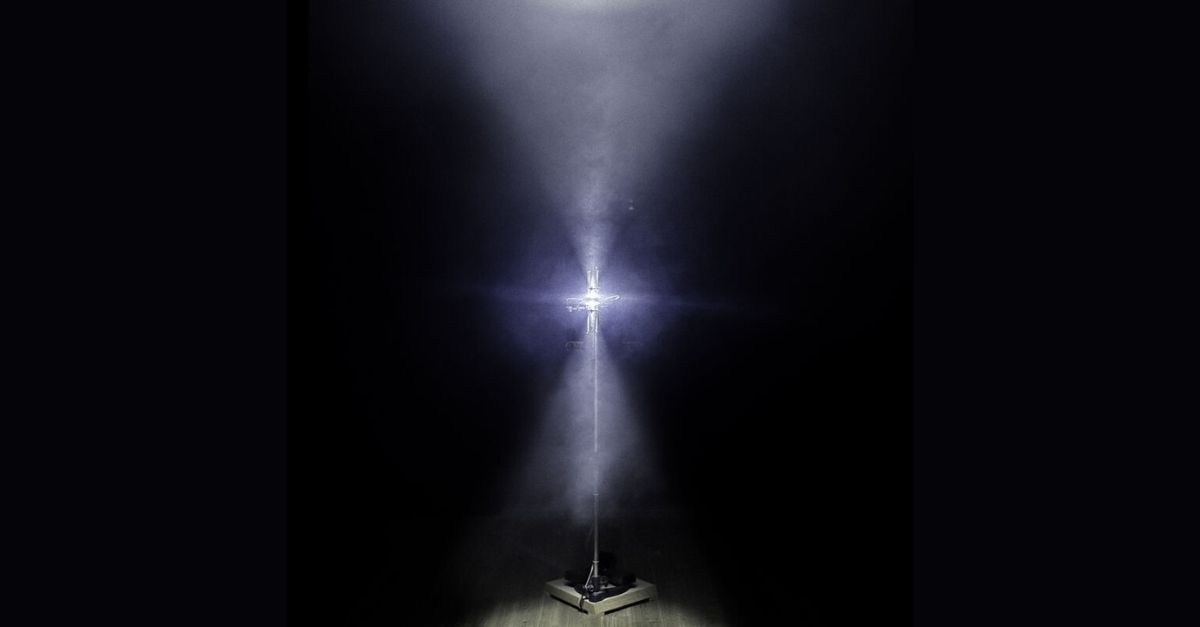
At the Round Tower this autumn, you can experience Light Echoes – an exhibition and research project exploring our understanding of light, time and the universe.
The exhibition is presented by the Round Tower and the Niels Bohr Institute’s Yonder | Art•Science Program, and one of the six artists involved is Pieter Steyaert, PhD student at the Department of Science Education.
Together with the NBI’s Jo Verwohlt, he is behind the artwork Light Cone.
“The speed of light sets the boundaries of cause and effect. It determines what could have happened before a given point in time, and what can happen in the future,” explains Pieter Steyaert.
“This relationship is often illustrated in textbooks with a model of a light cone. Everything that can be affected by what happens here in this moment lies within the future light cone. Everything that could have affected this moment lies within the past light cone.”
It is this abstract idea that has taken physical form in Light Cone.
Not a visualization, not an interpretation
The work combines light and sound to create a sculpture that responds to the space around it and changes over time. While the light recreates the two cones representing future and past, a soundscape unfolds in three acts, based on mathematical formulas describing light, gravity and causality.
“Light is also data, and we can represent it as frequencies. In this way, we use the formulas to create the sounds,” explains Pieter Steyaert.
“There is an artistic element on top of that, where we have selected sounds and given them character. It is not a visualization, but it is not an interpretation either.”
A natural step
For Pieter Steyaert, working at the intersection of art and science comes naturally. In Belgium, he studied art while co-founding the transdisciplinary art collective SEADS (Space Ecologies Art and Design). After that, he switched his studies to Computer Science and when the opportunity arose to write a PhD on artistic methods in exoplanet research, it seemed like a natural step.
“It did not feel like a big career change,” says Pieter Steyaert, who is part of the Marie Sklodowska-Curie Innovative Training Network (ITN) CHAMELEON.
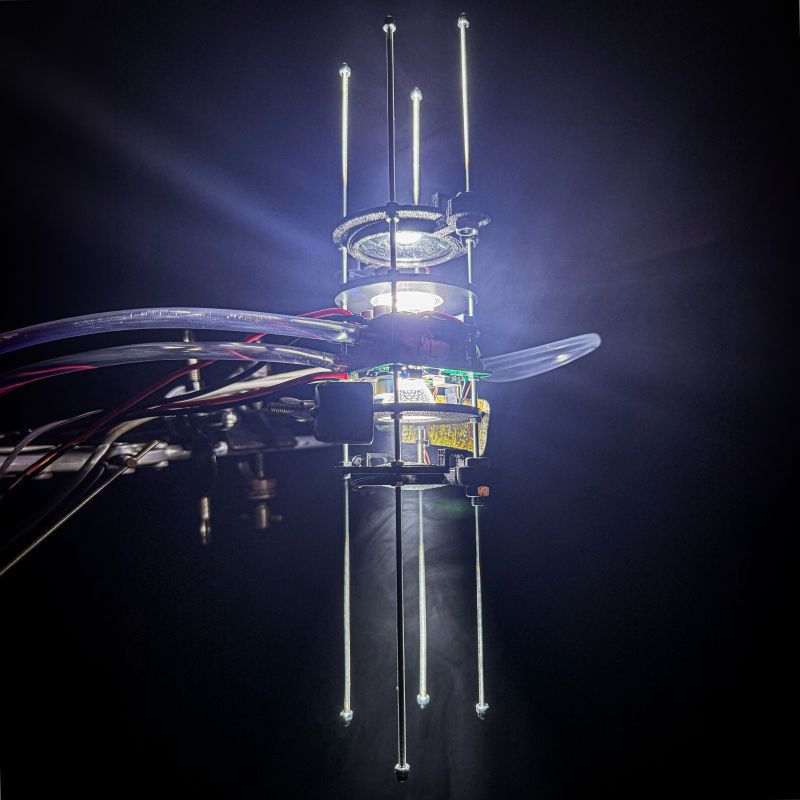
The collaboration with physicist and artist Jo Verwohlt has developed over the past two years, during which, in borrowed rooms in the Niels Bohr Building, they have 3D-printed, soldered and assembled the components of Light Cone.
“We use a powerful LED to create the light, and it turned out to get extremely hot and threatened to melt the entire installation,” says Pieter Steyaert.
“Therefore, we installed a water cooling system, which in turn becomes part of the work’s visual expression. All parts of the physical work have a function.”
Light Echoes can be experienced at the Round Tower until 3 January 2027.